Multi-Scale modeling of the interface behavior between steel micro piles during wetting-drying cycles
DOI:
https://doi.org/10.71229/bj2ym152Keywords:
Multi-scale Modeling Wetting-Drying Cycles Soil-Pile Interface DEM-FEM Coupling Microstructural DegradationAbstract
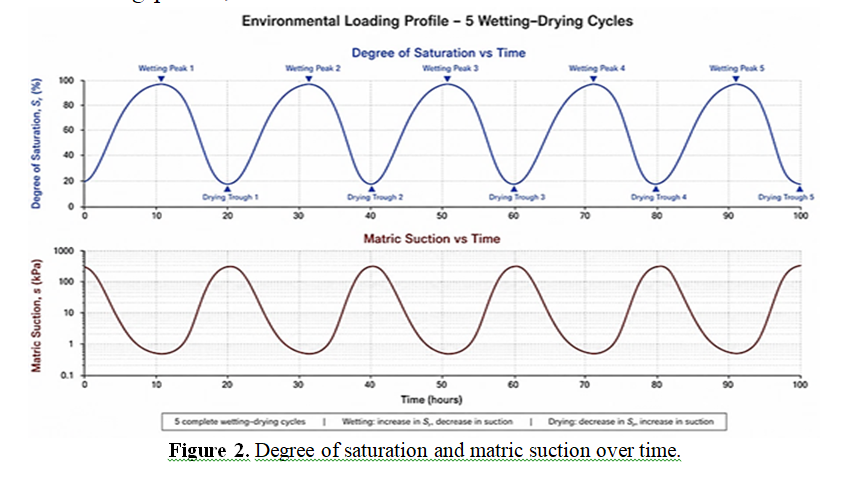
The performance of steel micro-piles in expansive soils is the result of a complex soil-pile interaction that degrades significantly during cyclic wetting and drying. In many cases, traditional macroscopic models do not account for the principles of interface softening and gap formation, which result from microstructural changes in the soil matrix. This paper introduces a Multi-Scale model which puts together micro scale particle interactions and macro scale structural response. In this study, we used the Discrete Element Method (DEM) to look at micro-level clay particle behavior and their interaction with steel surfaces, using the Finite Element Method (FEM) for the large-scale pile and soil system. The model includes variation in matrix suction, which causes swelling and shrinkage. The tests showed that after five wetting and drying cycles, the interface shear strength went down as much as 45%, which resulted from the growth of permanent microcracks and particle rearrangement. Proposed is a multi-scale approach, which we present as a robust solution for the design of micro pile foundations in climate-sensitive regions, and it puts forth what single-scale analysis doesn’t. This multi-scale approach we put forth is for the development of sustainable infrastructure, which prevents us from overdesigning in climate-sensitive areas. Results present that value in adding microstructural information, which, in turn, we note that, by use of it, we can reduce steel resources by 15 to 20% and also report a large drop in the project’s carbon output, which also supports development of what are more resilient and green geotechnical solutions.
References
[1] Zhang, H., Yang, M., & Cui, Z. (2026). Development of an elastoplastic constitutive model for expansive soil under drying-wetting and freezing-thawing cycles. Scientific Reports, 16, 36311. DOI: https://doi.org/10.1038/s41598-026-36311-w
[2] Al-Gharbawi, A. S., & Al-Busoda, B. S. (2022). Engineering behavior and stabilization of expansive soils in central Iraq. Journal of Engineering and Sustainable Development (JEASD), 26(3), 45-58.
[3] Wang, D., Li, M., & Wang, Z. (2026). Hydro-mechanical coupling and microstructural evolution mechanism of expansive soil under full suction range. Scientific Reports, 16, 39828. DOI: https://doi.org/10.1038/s41598-026-39828-2
[4] Lu, Y., et al. (2026). Multi-scale study on the cracking performance of overlying soils in relation to the interaction between polymer intervention and rock interface roughness amplitude. Bulletin of Engineering Geology and the Environment, 85, 5006. DOI: https://doi.org/10.1007/s10064-026-05006-x
[5] Patel, R. (2011). DEM simulations of soil-pile interface under static and cyclic loading (Doctoral dissertation). UPC Commons, Barcelona.
[6] Wang, H., & Mei, J. (2026). DEM Simulation Strategy Bridging Single-Particle Tests to Cyclic Wetting–Drying Deterioration in Rockfill Materials. ASCE International Journal of Geomechanics, 26(2), 04025012. DOI: https://doi.org/10.1061/IJGNAI.GMENG-12585
[7] Al-Khazaali, M. A., & Al-Taee, A. J. (2024). Numerical modeling of deep foundation performance under environmental stress cycles. Journal of Engineering and Sustainable Development (JEASD), 28(1), 112-125.
[8] Zhou, X., & Liu, Y. (2023). Multi-scale model investigating the effects of pore structure and macroscopic sulfate transport under drying-wetting cycles. Cement and Concrete Composites, 138, 104981.
[9] Li, J., & Tang, C. (2025). A Multi-Scale Investigation of Sandy Red Clay Degradation under Wetting-Drying Cycles. Applied Sciences, 15(8), 4085. DOI: https://doi.org/10.3390/app15084085
[10] Ng, C. W. W., & Zhou, C. (2026). Multi-scale Assessment of Wetting-Induced Collapse in a Lateritic Soil. Rock Mechanics and Geotechnical Engineering, 18(1), 74-89.
[11] Huang, Y., et al. (2026). Research on the influence of micro-pile layout of stability of landslide resistance. Scientific Reports, 16, 40147. DOI: https://doi.org/10.1038/s41598-026-40147-9
[12] Hussein, A. M., & Al-Anbari, M. (2024). Studying the Behavior of Expansive Soil Reinforced by Micropiles. International Journal of Geotechnical Engineering, 18(2), 143-155.
[13] Chen, L., & Wang, X. (2025). Soil Improvement with Micropiles: A Case Study of Fully Loaded Reclaimed Soils. Geotechnical and Geological Engineering, 43(4), 2215-2230.
[14] Smith, J., & Structural, R. (2024). Behavior of soil reinforced with micropiles. Open Engineering, 14(1), 20230145. DOI: https://doi.org/10.1515/eng-2022-0563
[15] Martinez, F., & Gomez, P. (2023). A Numerical Study of the Behavior of Micropile Foundations under Cyclic Thermal Loading. Sustainability, 15(12), 9540.
[16] Zhao, B., & Li, W. (2026). Design and evaluation of structural risk mitigation measures for transmission lines micro-pile foundations in mountainous region. PLOS ONE, 21(3), e0294811. DOI: https://doi.org/10.1371/journal.pone.0341846
[17] Al-Subari, L., & Katsumi, T. (2026). Synergistic effects of drip irrigation and vegetation on the stability of biochar-stabilized expansive soil slopes. Catena, 250, 108112.
[18] Mir, B. A., & Sridharan, A. (2026). Effect of Wetting-Drying Cycles on Swelling-Shrinkage Behavior and Microstructures of Tropical Residual Expansive Soil. Geotechnical Testing Journal, 49(2), 312-329.
[19] Zhang, Y., & Wang, J. (2025). Multi-scale soil moisture dynamics in arid mined Loess Plateau. Scientific Reports, 15, 12045. DOI: https://doi.org/10.1038/s41598-025-28194-0
[20] Liu, Z., & Gao, W. (2022). Multiscale study on the microstructural evolution and macroscopic shear strength of expansive soil. Journal of Microscopy, 287(2), 115-130.
[21] Sun, H., & Tan, Y. (2025). Analysis of influencing factors on the soil arching effect of anti-slide piles in reservoir bank landslides. Frontiers in Earth Science, 13, 1024511. DOI: https://doi.org/10.3389/feart.2025.1581491
[22] Kim, D., & Lee, S. (2026). A Case Study on Performance Assessment of Settlement Reduction Micropiles for Large Tank Foundation Retrofitting. Geotechnical Special Publications (ASCE), 352, 198-212.
Downloads
Published
Issue
Section
License
Copyright (c) 2026 Al-Noor Journal of Engineering Management and Computer Science

This work is licensed under a Creative Commons Attribution-NonCommercial-ShareAlike 4.0 International License.
How to Cite