Development of an Integrated CNC Technology Assessment Framework (ICTAF) for Smart CNC Technology Evaluation in Modern Manufacturing
DOI:
https://doi.org/10.71229/0y7zbp97Keywords:
Computer Numerical Control, Smart CNC Technology, Decision Support Framework, Technology Assessment, (ICTAF), Intelligent Manufacturing, Industry 4.0, Sustainable ManufacturingAbstract
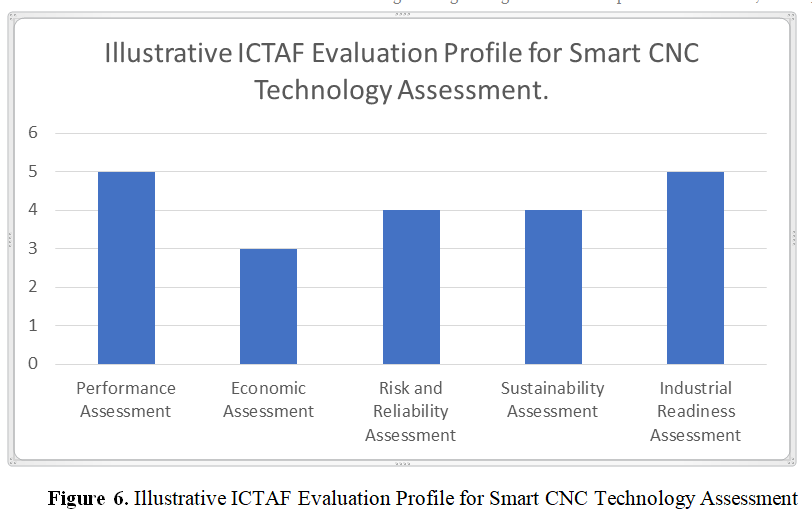
Computer Numerical Control (CNC) technology has become a fundamental component of modern manufacturing systems due to its capability to provide high accuracy, enhanced productivity, and flexible production performance. The continuous evolution of CNC systems has been driven by advances in motion control strategies, servo drive technologies, precision machining methods, sensing systems, and intelligent manufacturing solutions. This study develops an integrated decision-support framework for evaluating smart CNC technologies by considering multiple technical and industrial factors. A comprehensive analysis of recent CNC advancements is conducted to identify the key assessment dimensions influencing technology evaluation, including performance capability, economic feasibility, risk and reliability, sustainability considerations, and industrial readiness. Based on these requirements, the Integrated CNC Technology Assessment Framework (ICTAF) is proposed as a systematic methodology for supporting technology evaluation and adoption decisions in smart manufacturing environments. The proposed framework integrates technological characteristics with strategic assessment criteria to address the limitations of fragmented evaluation approaches commonly applied to CNC technology selection and implementation. The study demonstrates that effective evaluation of modern CNC systems requires a multidisciplinary perspective combining mechanical performance, control capabilities, digital integration, operational requirements, and sustainability considerations. The developed framework provides a structured approach for assessing smart CNC technologies and supports manufacturers in making informed decisions toward reliable, efficient, and sustainable manufacturing systems.
References
[1] Quan, L., Zhao, W., & Zhao, W. (2024). A review on positioning uncertainty in motion control for machine tool feed drives. Precision Engineering, 88, 428–448. DOI: https://doi.org/10.1016/j.precisioneng.2024.03.003
[2] Wang, X., Zhang, D., & Zhang, Z. (2023). A review of dynamics design methods for high-speed and high-precision CNC machine tool feed systems. arXiv:2307.03440.
[3] Ma, H., Shen, L., Jiang, X., Zou, Q., & Yuan, C. (2023). A survey of path planning and feedrate interpolation in computer numerical control. arXiv:2303.01368.
[4] Wang, Y., Cao, Y., Qu, X., Wang, M., Wang, Y., & Zhang, C. (2025). A review of the application of machine learning techniques in thermal error compensation for CNC machine tools. Measurement, 243, 116341. https://doi.org/10.1016/j.measurement.2024.116341 DOI: https://doi.org/10.1016/j.measurement.2024.116341
[5] Mu, S., Yu, C., Lin, K., Lu, C., Wang, X., Wang, T., & Fu, G. (2025). A review of machine learning-based thermal error modeling methods for CNC machine tools. Machines, 13(2), 153. https://doi.org/10.3390/machines13020153 DOI: https://doi.org/10.3390/machines13020153
[6] Zhang, Z., Jiang, F., Luo, M., Wu, B., Zhang, D., & Tang, K. (2024). Geometric error measuring, modeling, and compensation for CNC machine tools: A review. Chinese Journal of Aeronautics, 37(2), 163–198. https://doi.org/10.1016/j.cja.2023.02.035 DOI: https://doi.org/10.1016/j.cja.2023.02.035
[7] Altintas, Y., Verl, A., Brecher, C., Uriarte, P. L., & Pritschow, G. (2011). Machine tool feed drives. CIRP Annals – Manufacturing Technology, 60(2), 779–796. https://doi.org/10.1016/j.cirp.2011.05.010 DOI: https://doi.org/10.1016/j.cirp.2011.05.010
[8] Altintas, Y. (2012). Manufacturing automation: Metal cutting mechanics, machine tool vibrations, and CNC design (2nd ed.). Cambridge University Press. DOI: https://doi.org/10.1017/CBO9780511843723
[9] Moriwaki, T. (2008). Multi-functional machine tools. CIRP Annals – Manufacturing Technology, 57(2), 736–749. https://doi.org/10.1016/j.cirp.2008.09.004 DOI: https://doi.org/10.1016/j.cirp.2008.09.004
[10] Koren, Y. (1983). Computer control of manufacturing systems. McGraw-Hill.
[11] Altintas, Y., Brecher, C., Weck, M., & Witt, S. (2005). Virtual machine tool. CIRP Annals – Manufacturing Technology, 54(2), 115–138. https://doi.org/10.1016/S0007-8506(07)60022-5 DOI: https://doi.org/10.1016/S0007-8506(07)60022-5
[12] Gai, H., Li, X., Jiao, F., Cheng, X., Yang, X., & Zheng, G. (2021). Application of a new model reference adaptive control based on PID control in CNC machine tools. Machines, 9(11),274. https://doi.org/10.3390/machines9110274 DOI: https://doi.org/10.3390/machines9110274
[13] Zhang, T., Li, X., Gai, H., Zhu, Y., & Cheng, X. (2023). Integrated controller design and application for CNC machine tool servo systems based on model reference adaptive control and adaptive sliding mode control. Sensors, 23(24), 9755. https://doi.org/10.3390/s23249755 DOI: https://doi.org/10.3390/s23249755
[14] Altintas, Y., & Khosla, P. K. (2000). High speed servo control of multi-axis machine tools. International Journal of Machine Tools and Manufacture, 40(4), 539–559. https://doi.org/10.1016/S0890-6955(99)00075-9 DOI: https://doi.org/10.1016/S0890-6955(99)00075-9
[15] Wang, L., & Cao, J. (2012). A look-ahead and adaptive speed control algorithm for high-speed CNC equipment. The International Journal of Advanced Manufacturing Technology, 63, 705–717. https://doi.org/10.1007/s00170-012-3924-7 DOI: https://doi.org/10.1007/s00170-012-3924-7
[16] Ramesh, R., Mannan, M. A., & Poo, A. N. (2000). Error compensation in machine tools—A review: Part I: Geometric, cutting-force induced and fixture-dependent errors. International Journal of Machine Tools and Manufacture, 40(9), 1235–1256. https://doi.org/10.1016/S0890-6955(00)00009-2 DOI: https://doi.org/10.1016/S0890-6955(00)00009-2
[17] Ramesh, R., Mannan, M. A., & Poo, A. N. (2000). Error compensation in machine tools—A review: Part II: Thermal errors. International Journal of Machine Tools and Manufacture, 40(9), 1257–1284. https://doi.org/10.1016/S0890-6955(00)00010-9 DOI: https://doi.org/10.1016/S0890-6955(00)00010-9
[18] Weng, L., Kizaki, T., Ma, C., Gao, W., & Kono, D. (2025). A review of robust thermal error reduction of machine tools. International Journal of Machine Tools and Manufacture, 209, 104298. https://doi.org/10.1016/j.ijmachtools.2025.104298 DOI: https://doi.org/10.1016/j.ijmachtools.2025.104298
[19] Ko, J. H., & Yin, C. (2026). A review of artificial intelligence application for machining surface quality prediction: From key factors to model development. Journal of Intelligent Manufacturing, 37(2), 775–798. https://doi.org/10.1007/s10845-025-02571-y DOI: https://doi.org/10.1007/s10845-025-02571-y
[20] Yang, H., Mei, X., Zheng, Y., Jiang, G., Tao, T., & Shi, H. (2026). Digital twin-enabled thermal error prediction and compensation system for CNC machine tool feed systems. Mechanical Systems and Signal Processing, 250, 114192. https://doi.org/10.1016/j.ymssp.2025.114192 DOI: https://doi.org/10.1016/j.ymssp.2026.114192
[21] Koren, Y., Gu, X., & Guo, W. (2018). Reconfigurable manufacturing systems: Principles, design, and future trends. Frontiers of Mechanical Engineering, 13(2), 121–136. https://doi.org/10.1007/s11465-018-0483-0 DOI: https://doi.org/10.1007/s11465-018-0483-0
[22] Abele, E., Altintas, Y., & Brecher, C. (2010). Machine tool spindle units. CIRP Annals – Manufacturing Technology, 59(2), 781–802. https://doi.org/10.1016/j.cirp.2010.05.002 DOI: https://doi.org/10.1016/j.cirp.2010.05.002
[23] Yin, S., & Kaynak, O. (2015). Big data for modern industry: Challenges and trends. Proceedings of the IEEE, 103(2), 143–146. https://doi.org/10.1109/JPROC.2015.2388958 DOI: https://doi.org/10.1109/JPROC.2015.2388958
[24] Lasi, H., Fettke, P., Kemper, H.-G., Feld, T., & Hoffmann, M. (2014). Industry 4.0. Business & Information Systems Engineering, 6(4), 239–242. https://doi.org/10.1007/s12599-014-0334-4 DOI: https://doi.org/10.1007/s12599-014-0334-4
[25] Grieves, M., & Vickers, J. (2017). Digital twin: Mitigating unpredictable, undesirable emergent behavior in complex systems. In F.-J. Kahlen, S. Flumerfelt, & A. Alves (Eds.), Transdisciplinary perspectives on complex systems (pp. 85–113). Springer. https://doi.org/10.1007/978-3-319-38756-7_4 DOI: https://doi.org/10.1007/978-3-319-38756-7_4
Downloads
Published
Issue
Section
License
Copyright (c) 2026 Al-Noor Journal of Engineering Management and Computer Science

This work is licensed under a Creative Commons Attribution-NonCommercial-ShareAlike 4.0 International License.
How to Cite