Computer Vision Techniques -Based Financial Fraud Detection Using Ensemble Learning and Explainable Artificial Intelligence
DOI:
https://doi.org/10.71229/actc4s10Keywords:
Artificial Intelligence, , Deep Learning,, Financial Fraud, , Computer VisionAbstract
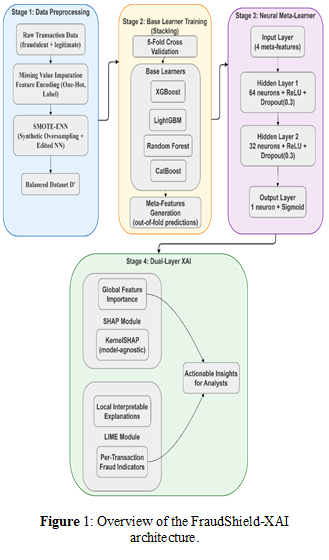
Financial fraud is a growing concern for the global economy, with hundreds of billions of dollars lost every year, and the traditional rule-based fraud detection systems are no longer effective because they are unable to cope with the increasing complexity of fraud schemes. In this paper, we propose FraudShield-XAI, an ensemble learning framework to produce high fraud detection performance and transparent/interpretable decision making, which uses a stacking-based framework consisting of XGBoost, random forests, and an adaptive neural network meta-learner. We evaluate and train the framework using two widely used datasets, the IEEE-CIS Fraud Detection dataset and the PaySim simulated mobile money transactions dataset, and in order to address the class imbalance issue that is typical in fraud detection problems, we apply the Synthetic Minority Oversampling Technique with Edited Nearest Neighbours (SMOTE-ENN). Our experimental results show that FraudShield-XAI outperforms traditional single-model based approaches with an AUC-ROC of 98.72%, an MCC of 0.923, and an F1-score of 97.84%, and we use SHAP and LIME to explain the predictions of FraudShield-XAI, providing the most influential features for each prediction. Identified key factors include transaction velocity, merchant category, and geographical deviations, which can offer actionable insights to compliance teams and fraud analysts, therefore, FraudShield-XAI bridges the performance vs. interpretability gap, which is essential for regulatory approval and real-world deployment in fintech settings.
References
[1] A. Abdallah, M. A. Maarof, and A. Zainal, “Fraud detection system: A survey,” J. Netw. Comput. Appl., vol. 68, pp. 90–113, 2016, doi: 10.1016/j.jnca.2016.04.007. DOI: https://doi.org/10.1016/j.jnca.2016.04.007
[2] S. Makki, Z. Assaghir, Y. Taher, R. Haque, M. S. Hacid, and H. Zeineddine, “An experimental study with imbalanced classification approaches for credit card fraud detection,” IEEE Access, vol. 7, pp. 93010–93022, 2019, doi: 10.1109/ACCESS.2019.2927266. DOI: https://doi.org/10.1109/ACCESS.2019.2927266
[3] V. Van Vlasselaer et al., “APATE: A novel approach for automated credit card transaction fraud detection using network-based extensions,” Decis. Support Syst., vol. 75, pp. 38–48, 2015, doi: 10.1016/j.dss.2015.04.013. DOI: https://doi.org/10.1016/j.dss.2015.04.013
[4] S. Itoo, M. Meenakshi, and S. Singh, “Comparison and analysis of logistic regression, Naïve Bayes and KNN machine learning algorithms for credit card fraud detection,” Int. J. Inf. Technol., vol. 13, no. 4, pp. 1503–1511, 2021, doi: 10.1007/s41870-021-00646-0. DOI: https://doi.org/10.1007/s41870-020-00430-y
[5] L. Breiman, “Random forests,” Mach. Learn., vol. 45, no. 1, pp. 5–32, 2001, doi: 10.1023/A:1010933404324. DOI: https://doi.org/10.1023/A:1010933404324
[6] P. Vincent, H. Larochelle, I. Lajoie, Y. Bengio, and P.-A. Manzagol, “Stacked denoising autoencoders: Learning useful representations in a deep network with a local denoising criterion,” J. Mach. Learn. Res., vol. 11, pp. 3371–3408, 2010, doi: 10.5555/1756006.1953039.
[7] G. Dorronsoro, J. Llorens, and O. Perez-Arriaga, “GDPR compliance in machine learning fraud detection systems: Challenges and approaches,” Inf. Syst. Front., vol. 24, no. 5, pp. 1613–1628, 2023, doi: 10.1007/s10796-021-10192-y. DOI: https://doi.org/10.1007/s10796-021-10192-y
[8] S. M. Lundberg and S.-I. Lee, “A unified approach to interpreting model predictions,” in Advances in Neural Information Processing Systems 30, I. Guyon et al., Eds. Red Hook, NY, USA: Curran Associates, Inc., 2017, pp. 4765–4774.
[9] E. A. Lopez-Rojas, A. Elmir, and S. Axelsson, “PaySim: A financial mobile money simulator for fraud detection,” in Proceedings of the 28th European Modeling and Simulation Symposium (EMSS), 2016, pp. 249–255.
[10] N. V. Chawla, K. W. Bowyer, L. O. Hall, and W. P. Kegelmeyer, “SMOTE: Synthetic minority over-sampling technique,” J. Artif. Intell. Res., vol. 16, pp. 321–357, 2002, doi: 10.1613/jair.953. DOI: https://doi.org/10.1613/jair.953
[11] D. H. Wolpert, “Stacked generalization,” Neural Netw., vol. 5, no. 2, pp. 241–259, 1992, doi: 10.1016/S0893-6080(05)80023-1. DOI: https://doi.org/10.1016/S0893-6080(05)80023-1
[12] M. K. Hussein, L. T. Alkahla, and E. A. Jameel, “Diabetes prediction using XGBoost and hyperparameter algorithms,” in Data Analytics and Management, 2025, pp. 205–216, doi: 10.1007/978-981-96-3355-5_17. DOI: https://doi.org/10.1007/978-981-96-3355-5_17
[13] S. Bhattacharyya, S. Jha, K. Tharakunnel, and J. C. Westland, “Data mining for credit card fraud: A comparative study,” Decis. Support Syst., vol. 50, no. 3, pp. 602–613, 2011, doi: 10.1016/j.dss.2010.08.008. DOI: https://doi.org/10.1016/j.dss.2010.08.008
[14] A. Dal Pozzolo, G. Boracchi, O. Caelen, C. Alippi, and G. Bontempi, “Credit card fraud detection: A realistic modeling and a novel learning strategy,” IEEE Trans. Neural Netw. Learn. Syst., vol. 29, no. 8, pp. 3784–3797, 2018, doi: 10.1109/TNNLS.2017.2736643. DOI: https://doi.org/10.1109/TNNLS.2017.2736643
[15] Y. Sahin and E. Duman, “Detecting credit card fraud by ANN and logistic regression,” in Proceedings of the 2011 International Symposium on Innovations in Intelligent Systems and Applications, 2011, pp. 315–319, doi: 10.1109/INISTA.2011.5946108. DOI: https://doi.org/10.1109/INISTA.2011.5946108
[16] Z. Liu et al., “Heterogeneous graph neural networks for malicious account detection,” in Proceedings of the 27th ACM International Conference on Information and Knowledge Management, 2018, pp. 2077–2085, doi: 10.1145/3269206.3272010. DOI: https://doi.org/10.1145/3269206.3272010
[17] K. Randhawa, C. K. Loo, M. Seera, C. P. Lim, and A. K. Nandi, “Credit card fraud detection using AdaBoost and majority voting,” IEEE Access, vol. 6, pp. 14277–14284, 2018, doi: 10.1109/ACCESS.2018.2806420. DOI: https://doi.org/10.1109/ACCESS.2018.2806420
[18] M. K. Hussein, A. Alqassab, and L. T. Alkahla, “Enhancing feature selection in network intrusion detection systems using a novel hybrid binary swarm algorithm,” Baghdad Sci. J., vol. 22, no. 1, pp. 0242–0250, 2025, doi: 10.21123/bsj.2025.10114. DOI: https://doi.org/10.21123/2411-7986.5007
[19] S. M. Lundberg et al., “From local explanations to global understanding with explainable AI for trees,” Nat. Mach. Intell., vol. 2, no. 1, pp. 56–67, 2020, doi: 10.1038/s42256-019-0138-9. DOI: https://doi.org/10.1038/s42256-019-0138-9
[20] M. T. Ribeiro, S. Singh, and C. Guestrin, “Why should I trust you? Explaining the predictions of any classifier,” in Proceedings of the 22nd ACM SIGKDD International Conference on Knowledge Discovery and Data Mining, 2016, pp. 1135–1144, doi: 10.1145/2939672.2939778. DOI: https://doi.org/10.1145/2939672.2939778
[21] G. Batista, R. C. Prati, and M. C. Monard, “A study of the behavior of several methods for balancing machine learning training data,” ACM SIGKDD Explor. Newsl., vol. 6, no. 1, pp. 20–29, 2004, doi: 10.1145/1007730.1007735. DOI: https://doi.org/10.1145/1007730.1007735
[22] C. Seiffert, T. M. Khoshgoftaar, J. Van Hulse, and A. Napolitano, “RUSBoost: A hybrid approach to alleviating class imbalance,” IEEE Trans. Syst., Man, Cybern. A, Syst., Humans, vol. 40, no. 1, pp. 185–197, 2010, doi: 10.1109/TSMCA.2009.2029559. DOI: https://doi.org/10.1109/TSMCA.2009.2029559
[23] M. K. Hussein, L. T. Alkahla, and A. Alqassab, “Hyperspectral image classification using hybrid swarm feature selection and ensemble classifier,” Ingénierie des Systèmes d’Information, vol. 29, no. 6, pp. 2367–2375, 2024, doi: 10.18280/isi.290624. DOI: https://doi.org/10.18280/isi.290624
[24] W. E. Zhang, Q. Z. Sheng, A. Alhazbi, and A. Mahmood, “Adversarial examples: Attacks and defenses for deep learning,” IEEE Trans. Neural Netw. Learn. Syst., vol. 32, no. 6, pp. 2387–2403, 2021, doi: 10.1109/TNNLS.2019.2921099.
Downloads
Published
Issue
Section
License
Copyright (c) 2026 Al-Noor Journal of Engineering Management and Computer Science

This work is licensed under a Creative Commons Attribution-NonCommercial-ShareAlike 4.0 International License.
How to Cite