A Proposed AI-Base Framework for Supporting LMS Cloud Migration Decisions
DOI:
https://doi.org/10.71229/x9639y61Keywords:
LMS, AI, Migration, Cloud Computing, Decision SupportAbstract
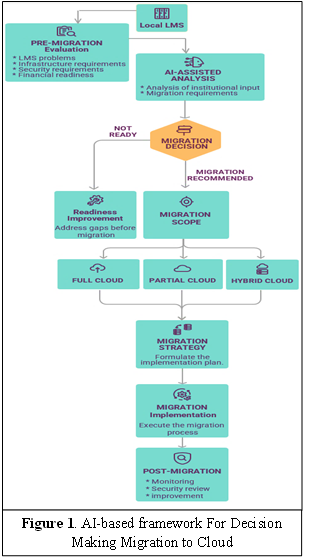
Educational institutions are increasingly confronted with the problems associated with locally hosted LMS infrastructure, including scalability issues, security risks, maintenance costs, and other challenges. Despite the considerable body of research on cloud adoption, readiness, and legacy systems migration, these issues are usually considered separately and do not provide sufficient support to educational institutions' decisions concerning the appropriateness of LMS migration to the cloud and its scope. In this regard, the study suggests an AI-Assisted LMS Cloud Migration Decision Framework, which combines institutional assessment before migration and AI-assisted analysis and recommendations on migration. Technical, operational, security, financial, and organizational factors are considered in the framework and used for assessing the possibility of migration and its appropriate scope for the institution based on these factors. Contrary to the assumption about the universal suitability of cloud migration, the suggested framework allows for considering three major migration alternatives: full, partial, or hybrid migration, as well as non-migration of the institution's current environment, in case of its unsuitability. AI is used in the process as a decision-making tool instead of a decision maker, and the ultimate decision is left to the institution itself.
References
[1] P. Hatta, Hadiyanto, and C. W. Budiyanto, “A systematic literature review of sustainable cloud computing adoption in higher education institutions covering architectures, critical factors, and green IT practices,” Discover Computing 2026 29:1, vol. 29, no. 1, pp. 266-, May 2026, doi: 10.1007/S10791-026-10160-7. DOI: https://doi.org/10.1007/s10791-026-10160-7
[2] Y. A. M. Qasem, R. Abdullah, Y. Y. Jusoh, R. Atan, and S. Asadi, “Cloud Computing Adoption in Higher Education Institutions: A Systematic Review.,” IEEE Access, vol. 7, pp. 63722–63744, 2019, doi: 10.1109/ACCESS.2019.2916234.
[3] S. S. Ghosh, A. Yadav, and B. Parashar, “Technology Roadmaps for Transition Management in Education: A Case Study on Implementing Sustainable IT-enabled Practices in Higher Education,” 2025 IEEE International Conference on Interdisciplinary Approaches in Technology and Management for Social Innovation, IATMSI 2025, 2025, doi: 10.1109/IATMSI64286.2025.10985519. DOI: https://doi.org/10.1109/IATMSI64286.2025.10985519
[4] A. Alharthi, M. O. Alassafi, R. J. Walters, and G. B. Wills, “An exploratory study for investigating the critical success factors for cloud migration in the Saudi Arabian higher education context,” Telematics and Informatics, vol. 34, no. 2, pp. 664–678, May 2017, doi: 10.1016/J.TELE.2016.10.008. DOI: https://doi.org/10.1016/j.tele.2016.10.008
[5] A. Mwotil, B. Kanagwa, A. Zawedde, T. E. Anderson, and E. Bainomugisha, “Cloud Adoption in Low Resource Settings: A Case Study of Higher Education Institutions in Uganda,” Lecture Notes of the Institute for Computer Sciences, Social-Informatics and Telecommunications Engineering, LNICST, vol. 587 LNICST, pp. 19–38, 2025, doi: 10.1007/978-3-031-81570-6_2/SAVE-RESEARCH.
[6] P. Kotiyal and M. Awasthi, “An Integrated Conceptual Framework for Cloud Computing Adoption in Sanskrit Universities in India,” 2025 IEEE International Conference on Computer, Electronics, Electrical Engineering and their Applications, IC2E3 2025, 2025, doi: 10.1109/IC2E365635.2025.11167173. DOI: https://doi.org/10.1109/IC2E365635.2025.11167173
[7] B. Althani, “Migration challenges of legacy software to the cloud: a socio-technical perspective,” Cogent Business & Management, vol. 12, no. 1, Dec. 2025, doi: 10.1080/23311975.2025.2503421. DOI: https://doi.org/10.1080/23311975.2025.2503421
[8] K. Abdelkader, R. Aki, S. Yedder, and R. Arfa, “Challenges and Factors Affecting Cloud Computing Adoption in Higher Technical Education Institutions in Libya,” 2021 IEEE 1st International Maghreb Meeting of the Conference on Sciences and Techniques of Automatic Control and Computer Engineering, MI-STA 2021 - Proceedings, pp. 310–315, May 2021, doi: 10.1109/MI-STA52233.2021.9464501. DOI: https://doi.org/10.1109/MI-STA52233.2021.9464501
[9] O. Dahham and H. Fawareh, “E-Learning Migration Model for Cloud-based Education,” Proceedings - 2022 23rd International Arab Conference on Information Technology, ACIT 2022, 2022, doi: 10.1109/ACIT57182.2022.9994219. DOI: https://doi.org/10.1109/ACIT57182.2022.9994219
[10] Y. A. M. Qasem, R. Abdullah, Y. Y. Jusoh, R. Atan, and S. Asadi, “Cloud Computing Adoption in Higher Education Institutions: A Systematic Review,” IEEE Access, vol. 7, pp. 63722–63744, Jan. 2019, doi: 10.1109/ACCESS.2019.2916234. DOI: https://doi.org/10.1109/ACCESS.2019.2916234
[11] H. Fawareh, O. Dahham, H. Aljawawdeh, and E. Al Daoud, “Evaluation of Cloud Computing for Advancement LMS through Different Environments,” International Journal of Advances in Soft Computing and its Applications, vol. 16, no. 3, pp. 125–148, 2024, doi: 10.15849/IJASCA.241130.08. DOI: https://doi.org/10.15849/IJASCA.241130.08
[12] P. G. Sawant, “AI-Driven Cloud Migration Framework for Distributed Oracle Databases: A Privacy-Preserving and Zero-Touch Automation Approach,” International Journal of Humanities and Information Technology, vol. 6, no. 03, pp. 25–30, Sep. 2024, doi: 10.21590/.
[13] S. R. Chanthati, “Leveraging Artificial Intelligence for smart cloud migration, reducing cost and enhancing efficiency,” World Journal of Advanced Engineering Technology and Sciences, vol. 15, no. 1, pp. 033–045, Apr. 2025, doi: 10.30574/WJAETS.2025.15.1.0191. DOI: https://doi.org/10.30574/wjaets.2025.15.1.0191
[14] A. Vaidya, M. K. Vankayalapati, J. Chan, S. Ibraimoski, and S. Moran, “A Generative AI Assistant to Accelerate Cloud Migration,” Jan. 2024, Accessed: Aug. 14, 2026. [Online]. Available: https://arxiv.org/abs/2401.01753v1
[15] A. Mwotil, B. Kanagwa, A. Zawedde, T. E. Anderson, and E. Bainomugisha, “Cloud Adoption in Low Resource Settings: A Case Study of Higher Education Institutions in Uganda,” Lecture Notes of the Institute for Computer Sciences, Social-Informatics and Telecommunications Engineering, LNICST, vol. 587 LNICST, pp. 19–38, 2025, doi: 10.1007/978-3-031-81570-6_2. DOI: https://doi.org/10.1007/978-3-031-81570-6_2
[16] F. Alemeye and F. Getahun, “Cloud readiness assessment framework and recommendation system,” IEEE AFRICON Conference, vol. 2015-November, Nov. 2015, doi: 10.1109/AFRCON.2015.7331995. DOI: https://doi.org/10.1109/AFRCON.2015.7331995
[17] N. Ahmad, Q. N. Naveed, and N. Hoda, “Strategy and procedures for Migration to the Cloud Computing,” 2018 IEEE 5th International Conference on Engineering Technologies and Applied Sciences, ICETAS 2018, Jul. 2018, doi: 10.1109/ICETAS.2018.8629101. DOI: https://doi.org/10.1109/ICETAS.2018.8629101
[18] A. Vaidya, M. K. Vankayalapati, J. Chan, S. Ibraimoski, and S. Moran, “A Generative AI Assistant to Accelerate Cloud Migration,” Jan. 2024, Accessed: Aug. 14, 2026. [Online]. Available: https://arxiv.org/abs/2401.01753v1
[19] A. V. Indukuri, “AI-Powered Cloud Migration: Transforming Enterprise Modernization Strategies,” Journal of Computer Science and Technology Studies, vol. 7, no. 2, pp. 567–575, Apr. 2025, doi: 10.32996/JCSTS.2025.7.2.60. DOI: https://doi.org/10.32996/jcsts.2025.7.2.60
[20] R. Khare, “Accelerating digital transformation: AI-driven frameworks for legacy-to-cloud data modernization,” World Journal of Advanced Engineering Technology and Sciences, vol. 15, no. 3, pp. 1241–1248, Jun. 2025, doi: 10.30574/WJAETS.2025.15.3.1061. DOI: https://doi.org/10.30574/wjaets.2025.15.3.1061
Downloads
Published
Issue
Section
License
Copyright (c) 2026 Al-Noor Journal of Engineering Management and Computer Science

This work is licensed under a Creative Commons Attribution-NonCommercial-ShareAlike 4.0 International License.
How to Cite