Impacts of the 2009 MUTCD Changes in Pedestrian Walking Speed on Delay
DOI:
https://doi.org/10.71229/x3cqvb44Keywords:
Pedestrian walking speed, MUTCD, Signalized intersections, Pedestrian clearance interval, Vehicle delayAbstract
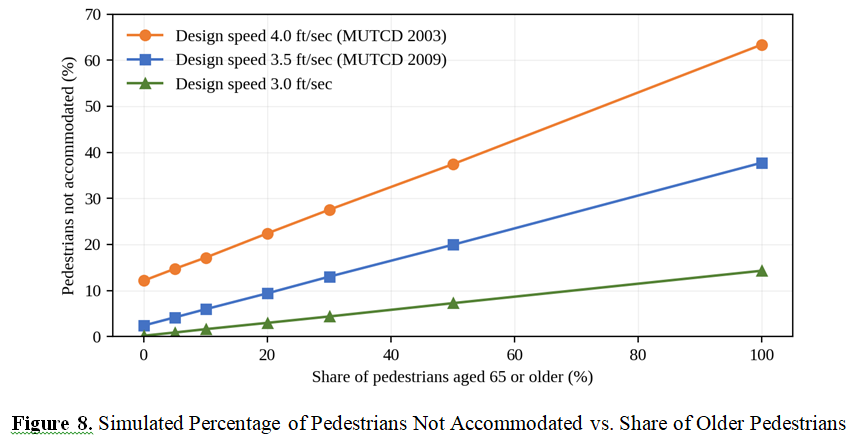
In the 2009 edition of the Manual on Uniform Traffic Control Devices (MUTCD), the walking speed used to time the pedestrian clearance interval was reduced from 4.0 ft/s (1.22 m/s) to 3.5 ft/s (1.07 m/s) to better accommodate older and mobility-impaired pedestrians. This paper evaluated the effect of this change on vehicle delay at signalized intersections where the pedestrian requirement controls the minimum green time. An analytical relation was derived which showed that the maximum increase in green time, and therefore in the delay of stopped vehicles, equals d(1/3.5 − 1/4), where d is the curb-to-curb crossing width; it is independent of the initial green time, phasing plan, and traffic volumes. The relation was tested with a computer simulation of 30,000 two-phase intersections and a population of simulated pedestrians. In the simulation, the share of intersections that needed added green time increased from 19.0% to 25.7%, and the maximum increase in green time was 3.14 s on an 88-ft street. The average control delay increased by 0.27 s/veh over all intersections and by 1.03 s/veh over the affected intersections, and the level of service became worse at 2.3% of the intersections. For a pedestrian population with 20% older pedestrians, the share of pedestrians who could not finish crossing within the clearance time fell from 22.4% to 9.4%. The change gave a clear benefit to pedestrians at a small average cost in vehicle delay.
References
[1] Koonce, P., et al. (2008). Traffic signal timing manual (Report No. FHWA-HOP-08-024). Federal Highway Administration.
[2] Federal Highway Administration. (2003). Manual on uniform traffic control devices for streets and highways (2003 ed.). U.S. Department of Transportation.
[3] Federal Highway Administration. (2009). Manual on uniform traffic control devices for streets and highways (2009 ed.). U.S. Department of Transportation.
[4] LaPlante, J., & Kaeser, T. P. (2007, June). A history of pedestrian signal walking speed assumptions. In Proceedings of the 3rd Urban Street Symposium, Seattle, WA, USA.
[5] LaPlante, J., & Kaeser, T. P. (2004). The continuing evolution of pedestrian walking speed assumptions. ITE Journal, 74(9), 32–40.
[6] Knoblauch, R. L., Pietrucha, M. T., & Nitzburg, M. (1996). Field studies of pedestrian walking speed and start-up time. Transportation Research Record, 1538, 27–38. https://doi.org/10.3141/1538-04
[7] Coffin, A., & Morrall, J. (1995). Walking speeds of elderly pedestrians at crosswalks. Transportation Research Record, 1487, 63–67.
[8] Fitzpatrick, K., Brewer, M. A., & Turner, S. (2006). Another look at pedestrian walking speed. Transportation Research Record, 1982, 21–29.
[9] Gates, T. J., Noyce, D. A., Bill, A. R., & Van Ee, N. (2006). Recommended walking speeds for timing of pedestrian clearance intervals based on characteristics of the pedestrian population. Transportation Research Record, 1982, 38–47. https://doi.org/10.3141/1982-07
[10] Forde, A., & Daniel, J. (2021). Pedestrian walking speed at un-signalized midblock crosswalk and its impact on urban street segment performance. Journal of Traffic and Transportation Engineering (English Edition), 8(1), 57–69. https://doi.org/10.1016/j.jtte.2019.03.007
[11] Schultz, G. G., Eggett, D. L., & Berrett, J. J. (2019). Pedestrian walking speeds at signalized intersections in Utah (Report No. UT-19.06). Utah Department of Transportation.
[12] Duim, E. L., Lebrão, M. L., & Antunes, J. L. F. (2017). Walking speed of older people and pedestrian crossing time. Journal of Transport & Health, 5, 70–76. https://doi.org/10.1016/j.jth.2017.02.001
[13] Western, M. J., Withall, J., Sheppard, R., Greaves, C., Hillsdon, M., & Stathi, A. (2025). Why didn’t the senior citizen cross the road? Gait speed in community-dwelling older adults with mobility limitations relative to pedestrian crossing times. Age and Ageing, 54(12), Article afaf345. https://doi.org/10.1093/ageing/afaf345
[14] Huang, Y., Shi, C., Dong, S., Zhang, S., Xu, L., & Nian, G. (2025). Measuring spatial accessibility for wheelchair users: A case study in a Chinese campus. PLOS ONE, 20(12), Article e0335663. https://doi.org/10.1371/journal.pone.0335663
[15] Giannoulaki, M., & Christoforou, Z. (2024). Pedestrian walking speed analysis: A systematic review. Sustainability, 16(11), Article 4813. https://doi.org/10.3390/su16114813
[16] Kim, H.-K., & Hunter, M. P. (2005). Effect of pedestrian-related factors on intersection performance. Transportation Research Record, 1920, 65–73.
[17] Yu, C., Ma, W., Han, K., & Yang, X. (2017). Optimization of vehicle and pedestrian signals at isolated intersections. Transportation Research Part B: Methodological, 98, 135–153. https://doi.org/10.1016/j.trb.2016.12.015
[18] Roshandeh, A. M., Levinson, H. S., Li, Z., Patel, H., & Zhou, B. (2014). New methodology for intersection signal timing optimization to simultaneously minimize vehicle and pedestrian delays. Journal of Transportation Engineering, 140(5), Article 04014009. https://doi.org/10.1061/(ASCE)TE.1943-5436.0000658
[19] Gavric, S., et al. (2022). Development and evaluation of non-traditional pedestrian timing treatments for coordinated signalized intersections. Transportation Research Record.
[20] Cabe, R., et al. (2026). The safety impacts of pedestrian delay at signalized intersections. Accident Analysis & Prevention.
[21] Al-Arkawazi, S. A. F. (2018). Measuring the influences and impacts of signalized intersection delay reduction on the fuel consumption, operation cost and exhaust emissions. Civil Engineering Journal, 4(3), 552. https://doi.org/10.28991/cej-0309115
[22] Sharma, N., Kumar, P. V. P., Dhyani, R., Ravisekhar, C., & Ravinder, K. (2019). Idling fuel consumption and emissions of air pollutants at selected signalized intersections in Delhi. Journal of Cleaner Production, 212, 8–21. https://doi.org/10.1016/j.jclepro.2018.11.275
[23] Bivina, G. R., Landge, V., & Kumar, V. S. (2016). Socio economic valuation of traffic delays. Transportation Research Procedia, 17, 513–522.
[24] Transportation Research Board. (2010). Highway capacity manual 2010 (5th ed.).
[25] Wu, J., Zhang, S., Singh, A. K., & Wang, Q. (2016). Pedestrian walking speed characteristics at signalized intersections in new urban district communities. In Proceedings of the 1st International Conference on Transportation Infrastructure and Materials (ICTIM). DEStech Transactions on Engineering and Technology Research. https://doi.org/10.12783/dtetr/ictim2016/5526
Downloads
Published
Issue
Section
License
Copyright (c) 2026 Al-Noor Journal of Engineering Management and Computer Science

This work is licensed under a Creative Commons Attribution-NonCommercial-ShareAlike 4.0 International License.
How to Cite