Thermal Performance of Steel-Faced Foamed Concrete Sandwich Panels for Building Envelopes under Elevated Temperatures
DOI:
https://doi.org/10.71229/wj7sqr04Keywords:
Foamed Concrete, , Shear Connectors, Thermal Performance, Fire Resistance, Bond ResistanceAbstract
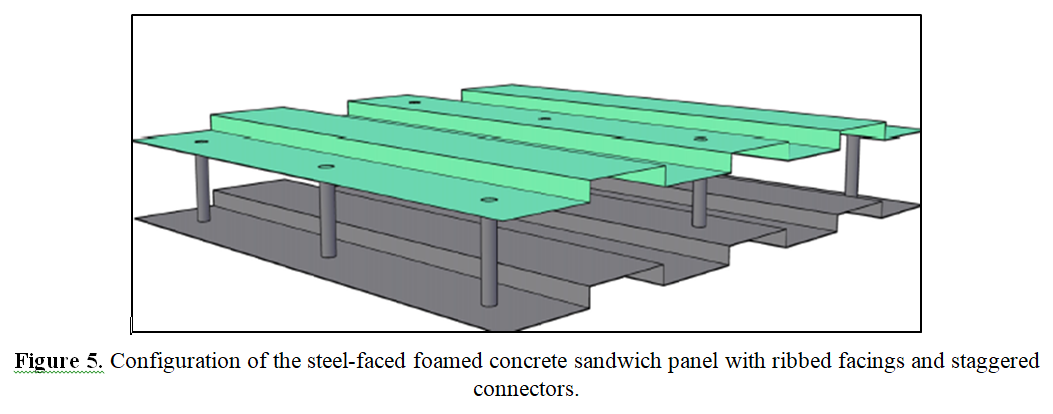
Enhancing the fire resistance of construction elements is considered one of the primary goals of recent studies. Consequently, since sandwich panels are among the most vulnerable construction elements, greater attention should be paid to improving their fire behavior. This study experimentally investigated the thermal performance and interface behavior of steel-faced foamed concrete sandwich panels subjected to direct flame exposure. The effects of rib spacing (R10 and R15), connector configuration (6 and 9 connectors), and core strength were experimentally evaluated using eight steel-faced foamed concrete sandwich panel specimens. Two target compressive strengths (2.5 MPa (M1) and 4.0 MPa (M2)) foamed concrete mixes were adopted as core materials. The specimens were subjected to direct flame for 25 minutes, and the temperatures of both exposed and unexposed surfaces were recorded throughout the experiment using infrared thermography (IRT). There was a definite thermal gradient between all specimens tested, with the exposed surface always measuring higher temperatures than the unexposed surface. The temperature difference (ΔT) between the two surfaces varied from around 137°C to a maximum of about 586°C during the heating duration, confirming that these sandwich panels can limit heat transfer through the panel thickness and amount for good thermal insulation. Dominant and secondary parameters were identified based on their influence to the thermal behavior, with rib spacing being dominating parameter and connector configuration showing secondary impact attributed to thermal bridging. Thermal exposure also resulted in moisture evaporation, crack and debonding between the steel face sheets and foamed concrete core. It further highlighted the importance of interface integrity to maintain thermal performance under elevated-temperature conditions due to the associated changes in temperature distribution and thermal gradients across the panel thickness observed at these damage mechanisms.
References
Reference
[1] Rosenbom A. After the fire, risk consulting. Risk Management Journal 2013; 6–9.
[2] Patekar V, Kale K. State of the art review on mechanical properties of sandwich composite structures. Polymer Composites 2022; 43: 5820–5830. DOI: https://doi.org/10.1002/pc.26989
[3] Shin D-H, Kim H-J. Composite effects of shear connectors used for lightweight-foamed-concrete sandwich wall panels. Journal of Building Engineering 2020; 29: 101108. DOI: https://doi.org/10.1016/j.jobe.2019.101108
[4] O’Hegarty R, Kinnane O. Review of precast concrete sandwich panels and their innovations. Construction and Building Materials 2020; 233: 117145. DOI: https://doi.org/10.1016/j.conbuildmat.2019.117145
[5] Qiao W, Kang J, Wang D, et al. Shaking table test on insulated sandwich concrete wall building structure. Journal of Building Engineering 2021; 37: 102165. DOI: https://doi.org/10.1016/j.jobe.2021.102165
[6] PCI Committee. State of the art of precast/prestressed concrete sandwich wall panels. PCI journal 2011; 56: 131–176. DOI: https://doi.org/10.15554/pcij56.2-06
[7] Eltayeb E, Ma X, Zhuge Y, et al. Dynamic performance of rubberised concrete and its structural applications – An overview. Engineering Structures 2021; 234: 111990. DOI: https://doi.org/10.1016/j.engstruct.2021.111990
[8] Priyatham BPRVS, Lakshmayya MTS, Chaitanya DVSRK. Review on performance and sustainability of foam concrete. Materials Today: Proceedings. Epub ahead of print 2023. DOI: https://doi.org/10.1016/j.matpr.2023.04.080. DOI: https://doi.org/10.1016/j.matpr.2023.04.080
[9] Fu Y, Wang X, Wang L, et al. Foam Concrete: A State-of-the-Art and State-of-the-Practice Review. Advances in Materials Science and Engineering 2020; 2020: 6153602. DOI: https://doi.org/10.1155/2020/6153602
[10] Kou R, Guo M-Z, Shi Y, et al. Sound-insulation and photocatalytic foamed concrete prepared with dredged sediment. Journal of Cleaner Production 2022; 356: 131902. DOI: https://doi.org/10.1016/j.jclepro.2022.131902
[11] Sulik P, Kukfisz B, Dowbysz A, et al. Fire Resistance of Foamed Concrete for Discontinuous Partition Filling. Materials 2024; 17: 1315. DOI: https://doi.org/10.3390/ma17061315
[12] Wang B, Chen Y, Fan H, et al. Investigation of low-velocity impact behaviors of foamed concrete material. Composites Part B: Engineering 2019; 162: 491–499. DOI: https://doi.org/10.1016/j.compositesb.2019.01.021
[13] Flores-Johnson EA, Li QM. Structural behaviour of composite sandwich panels with plain and fibre-reinforced foamed concrete cores and corrugated steel faces. Composite Structures 2012; 94: 1555–1563. DOI: https://doi.org/10.1016/j.compstruct.2011.12.017
[14] Al-Sibahy A, Edwards R. Mechanical and thermal properties of novel lightweight concrete mixtures containing recycled glass and metakaolin. Construction and Building Materials 2012; 31: 157–167. DOI: https://doi.org/10.1016/j.conbuildmat.2011.12.095
[15] Al-Sibahy A, Edwards R. Thermal behaviour of novel lightweight concrete at ambient and elevated temperatures: Experimental, modelling and parametric studies. Construction and Building Materials 2012; 31: 174–187. DOI: https://doi.org/10.1016/j.conbuildmat.2011.12.096
[16] Al-Sibahy A, Edwards R. Behaviour of masonry wallettes made from a new concrete formulation under compression loads at ambient temperatures: Testing and modelling. Construction and Building Materials 2014; 63: 271–280. DOI: https://doi.org/10.1016/j.conbuildmat.2014.04.043
[17] Dong X, Lu Y, Xiao H, et al. Effects of various connectors on the whole-life-cycle energy consumption of sandwich wall panels in five thermal zones of China. Energy and Buildings 2023; 280: 112733. DOI: https://doi.org/10.1016/j.enbuild.2022.112733
[18] Woltman G, Noel M, Fam A. Experimental and numerical investigations of thermal properties of insulated concrete sandwich panels with fiberglass shear connectors. Energy and Buildings 2017; 145: 22–31. DOI: https://doi.org/10.1016/j.enbuild.2017.04.007
[19] Bida SM, Abdul Aziz FNA, Jaafar MS, et al. Thermal Resistance of Insulated Precast Concrete Sandwich Panels. International Journal of Concrete Structures and Materials 2021; 15: 41. DOI: https://doi.org/10.1186/s40069-021-00477-6
[20] Pérez-Lombard L, Ortiz J, Pout C. A review on buildings energy consumption information. Energy and Buildings 2008; 40: 394–398. DOI: https://doi.org/10.1016/j.enbuild.2007.03.007
[21] Ahmad A, Maslehuddin M, Al-Hadhrami LM. In situ measurement of thermal transmittance and thermal resistance of hollow reinforced precast concrete walls. Energy and Buildings 2014; 84: 132–141. DOI: https://doi.org/10.1016/j.enbuild.2014.07.048
[22] Daniel IM, Gdoutos EE, Rajapakse YD. Major accomplishments in composite materials and sandwich structures: an anthology of ONR sponsored research. 1st edn. Dordrecht, Netherlands: Springer Science & Business Media, 2009. DOI: https://doi.org/10.1007/978-90-481-3141-9. DOI: https://doi.org/10.1007/978-90-481-3141-9
[23] Hayman B. Approaches to Damage Assessment and Damage Tolerance for FRP Sandwich Structures. Jnl of Sandwich Structures & Materials 2007; 9: 571–596. DOI: https://doi.org/10.1177/1099636207070853
[24] Burlayenko VN, Sadowski T. Influence of skin/core debonding on free vibration behavior of foam and honeycomb cored sandwich plates. International Journal of Non-Linear Mechanics 2010; 45: 959–968. DOI: https://doi.org/10.1016/j.ijnonlinmec.2009.07.002
[25] Mitra N, Raja BR. Improving delamination resistance capacity of sandwich composite columns with initial face/core debond. Composites Part B: Engineering 2012; 43: 1604–1612. DOI: https://doi.org/10.1016/j.compositesb.2011.11.039
[26] Imielińska K, Guillaumat L, Wojtyra R, et al. Effects of manufacturing and face/core bonding on impact damage in glass/polyester–PVC foam core sandwich panels. Composites Part B: Engineering 2008; 39: 1034–1041. DOI: https://doi.org/10.1016/j.compositesb.2007.11.007
[27] Pan M, He Y, Tian G, et al. Defect characterisation using pulsed eddy current thermography under transmission mode and NDT applications. NDT & E International 2012; 52: 28–36. DOI: https://doi.org/10.1016/j.ndteint.2012.08.007
[28] ACI Committee. ACI PRC-234-06: Guide for the Use of Silica Fume in Concrete (Reapproved 2012).
[29] Pham TM. Fibre-reinforced concrete: State-of-the-art-review on bridging mechanism, mechanical properties, durability, and eco-economic analysis. Case Studies in Construction Materials 2025; 22: e04574. DOI: https://doi.org/10.1016/j.cscm.2025.e04574
Downloads
Published
Issue
Section
License
Copyright (c) 2026 Al-Noor Journal of Engineering Management and Computer Science

This work is licensed under a Creative Commons Attribution-NonCommercial-ShareAlike 4.0 International License.
How to Cite